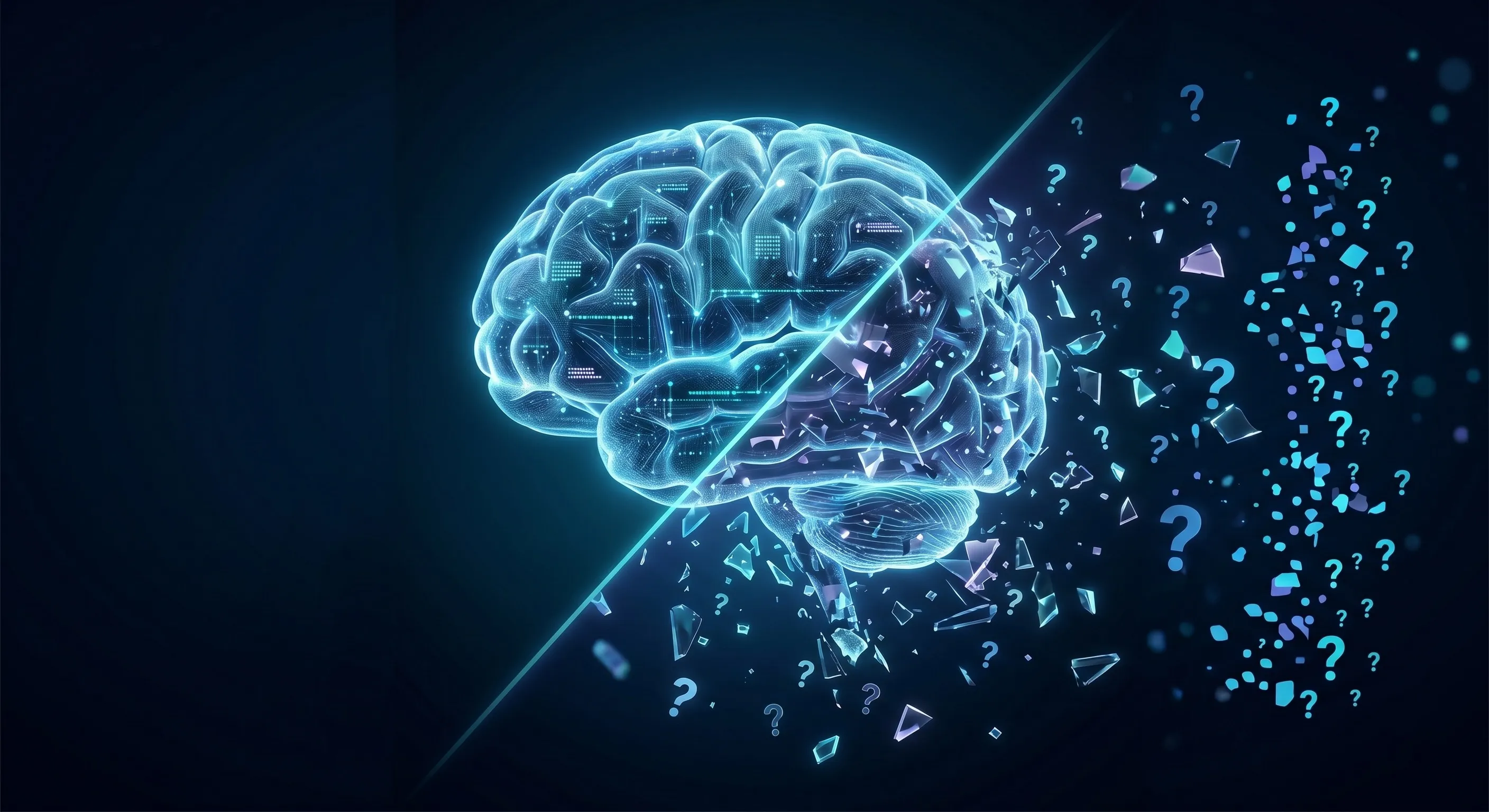
If you've used ChatGPT or any other AI chatbot, you've probably run into this: the AI states something confidently that turns out to be completely wrong. This is called AI hallucination and knowing when it happens makes you a far more effective user.
If you've spent any time with ChatGPT, Claude, or Gemini, you've probably seen it happen. You ask something, the AI gives a detailed, confident-sounding answer and then you look it up and realize it simply isn't true. The cited article doesn't exist. The statistic was invented. The person named never did what the AI described.
This is called AI hallucination, and it's one of the most important things to understand if you're going to use these tools effectively.
What exactly is AI hallucination?
AI hallucination means that a language model generates information that is false or nonexistent, while presenting it with apparent confidence and coherence.
The term is a bit misleading: the AI isn't seeing things or daydreaming. "Hallucination" here refers to the fact that the model produces content that looks and sounds real, but isn't.
Why does it happen?
Large language models like ChatGPT, Claude, and Gemini learn from enormous amounts of text. They learn how words, sentences, and ideas follow each other. But they don't have genuine knowledge of the world, and they don't verify information against real sources.
When they don't know something for certain, they don't say "I don't know." Instead, they generate something that fits the expected shape of an answer. That's the core problem.
Three common patterns:
1. Fabricated references. You ask for sources on a topic, and the AI produces a perfectly formatted citation: author, year, journal title. You search for it. It doesn't exist.
2. Wrong facts. "Who won the gold medal in X event at the 1984 Olympics?" You might get a name. Just not the right one.
3. Invented people or organizations. When the AI is uncertain, it sometimes invents names, companies, or laws that sound plausible but have no basis in reality.
When is hallucination most likely?
The risk is higher when you ask for:
Specific, verifiable data (numbers, dates, names)
Information about lesser-known people or organizations
Recent events near the edges of the model's training data
Academic or professional citations and sources
The risk is lower when you ask for:
Explanations of general concepts
Help with writing, brainstorming, or structuring ideas
Rephrasing or improving text you've already written
What can you do about it?
Verify before you share. If you're citing a specific fact, name, or date that came from an AI, look it up in a reliable source before passing it on. This matters especially when you're using the output professionally or publicly.
Ask the AI to flag its uncertainty. Prompting with "Are you certain about this? Do you have sources?" often leads better models to acknowledge when they're not sure. It doesn't always work, but it helps.
Use it for what it's actually good at. Writing, brainstorming, structuring, explaining these are reliable but facts, citations, specific data always must be verify elsewhere.
Try Perplexity for research tasks. If your goal is to look something up, use a tool that shows you its sources, like Perplexity AI. That way you can see where the information is coming from.
The bottom line
AI hallucination doesn't mean AI is a bad tool. It means AI can't always verify, and when it can't, it may still answer confidently.
Knowing this, you don't need to be afraid of AI but you also can't assume everything it says is accurate. The right approach: use it where it genuinely helps, and keep your critical thinking for the parts that need checking.
Even with hallucination as a limitation, these tools are remarkably useful. You just need to know when to put a question mark behind the answer.